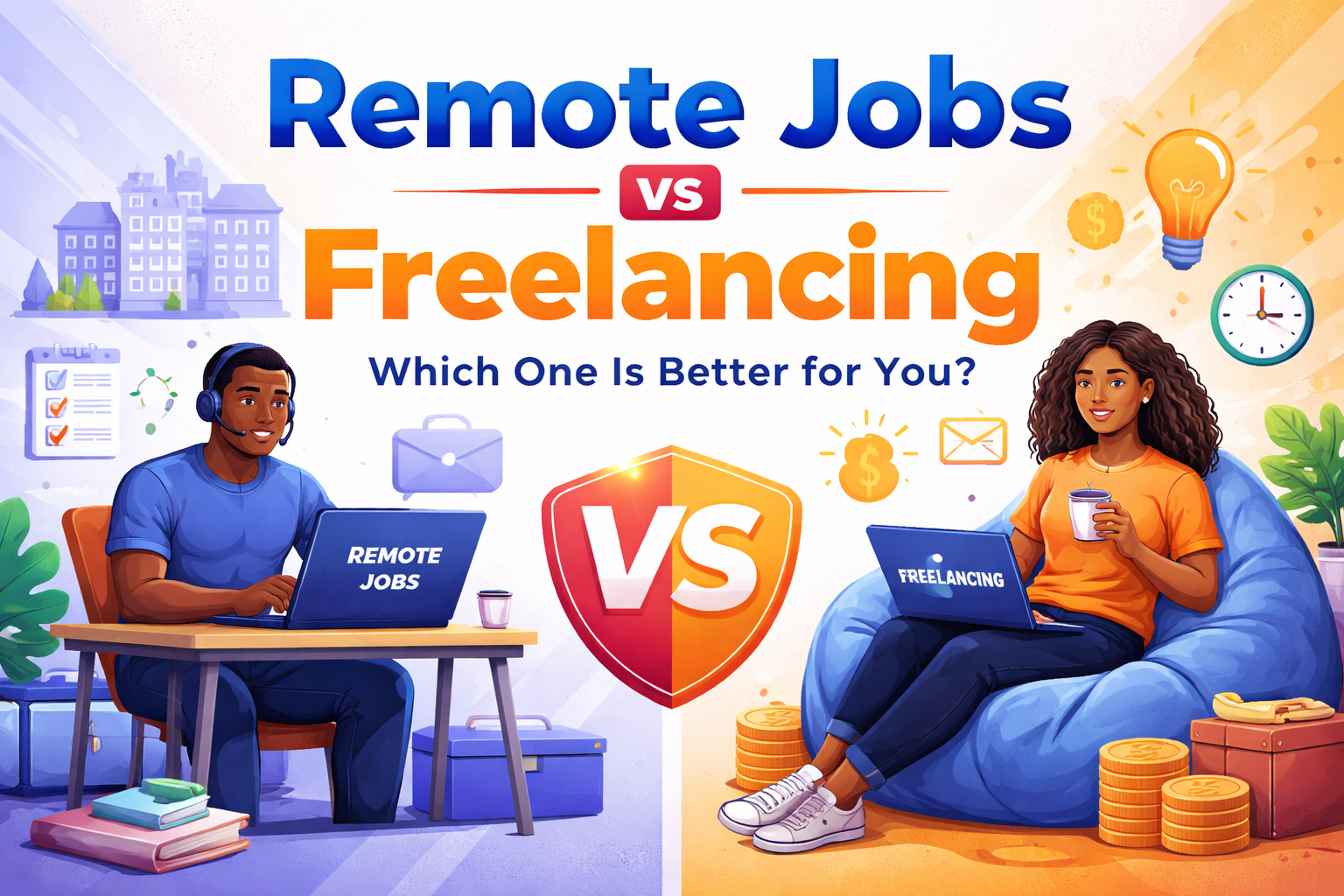
If you’re just starting your journey into online work, one of the biggest questions you’ll face is this: Should you go for a remote job or start freelancing?
At first glance, both options may seem similar. After all, they both allow you to work from home, earn online, and avoid the traditional office environment. But once you look closer, you’ll realize they operate very differently.
Understanding the difference between remote jobs and freelancing is important because it helps you choose the path that fits your personality, your goals, and your current level of experience.
Before diving in, if you’re still new to working online and haven’t figured out how to begin, you should first read this guide on getting started: How to Start Working From Home With No Experience
That foundation will make everything in this guide much easier to understand.
What Is a Remote Job?
A remote job is similar to a traditional job, but instead of working in a physical office, you work online from your home or any location of your choice.
You are hired by a company, assigned a role, and expected to complete tasks regularly. In most cases, you’ll have:
- A manager or supervisor
- A defined job role
- Fixed or semi-flexible working hours
- A consistent monthly salary
For example, if you work as a remote customer support agent, your job may involve responding to emails, handling customer complaints, or assisting users through live chat.
The key thing to understand is that remote jobs provide structure. You are part of a system, and your responsibilities are clearly defined.
What Is Freelancing?
Freelancing, on the other hand, is completely different.
Instead of working for one company, you work independently and offer your services to different clients. You are not tied to a single employer, and you decide:
- Who you work with
- What projects you take
- How much you charge
- When you work
For example, a freelance writer may write blog posts for multiple clients, while a graphic designer may create logos for different businesses.
Freelancing gives you more freedom, but it also comes with more responsibility.
The Core Differences You Should Know
Although both paths allow you to work online, the differences between them are significant.
1. Structure vs Freedom
Remote jobs are structured. You follow company guidelines and schedules. Freelancing gives you full control over your work and time.
2. Income Stability
Remote jobs usually provide a stable monthly income. Freelancing income can vary depending on how many clients or projects you have.
3. Job Security
With remote jobs, you may enjoy more stability, especially if you work with a long-term employer. Freelancers must constantly look for new clients.
4. Control Over Work
Freelancers have full control over pricing, workload, and clients. Remote workers follow company decisions.
5. Career Growth
Remote jobs often offer promotions and structured career growth. Freelancers grow by increasing their rates and building a strong reputation.
Advantages of Remote Jobs
Remote jobs are often the best starting point for beginners.
One major benefit is stability. You receive a predictable income, which makes financial planning easier.
Another advantage is guidance. Since you are part of a team, you get instructions and support, especially if you are new.
You also benefit from structured learning. Many companies train their employees, helping you build skills faster.
For someone just starting out, this environment reduces confusion and helps you gain confidence.
Advantages of Freelancing
Freelancing offers a different kind of opportunity.
The biggest advantage is freedom. You decide your schedule, your clients, and your workload.
There is also higher income potential. As you gain experience, you can increase your rates and earn significantly more than a fixed salary.
Freelancing also allows you to build multiple income streams. You are not dependent on one employer, which can be a strong financial advantage.
Challenges of Remote Jobs
Even though remote jobs are stable, they come with limitations.
You may have less flexibility, especially if your employer requires fixed working hours. Some roles also come with strict performance expectations.
Competition can also be high, particularly for international remote roles that pay well.
Challenges of Freelancing
Freelancing is not as easy as it looks.
The biggest challenge is inconsistency. There may be times when you have many clients, and other times when work is slow.
You are also responsible for everything—finding clients, communicating, delivering work, and managing payments.
For beginners, this can feel overwhelming at first.
Which One Is Better for You as a Beginner?
If you are just starting out, remote jobs are usually the better option.
They provide:
- Stability
- Structure
- Learning opportunities
- Real work experience
Freelancing, on the other hand, is better suited for people who already have some level of skill and confidence.
That said, your long-term goal does not have to be limited to one path.
A Smarter Strategy: Combine Both
One of the best approaches is to start with a remote job and then gradually move into freelancing.
For example:
- You start as a remote customer support agent
- You gain experience and improve your communication skills
- You begin offering freelance services on the side
- Over time, you increase your freelance income
This way, you enjoy stability while building independence.
How This Fits Into Your Remote Work Journey
By now, your understanding should be growing step by step.
You’ve already learned:
- What remote jobs are
- How to start without experience
- The difference between remote jobs and freelancing
Each step is building your foundation.
The next stage is to focus on skills—because skills are what actually get you paid.
Next Step in Your Learning Journey
Now that you understand which path may be right for you, the next thing you need is a clear idea of the skills that can help you start and grow in remote work.
👉 Next, read:
The Complete Guide to Landing Your First Remote Job
Final Thoughts
There is no single “perfect” choice between remote jobs and freelancing. The best option depends on where you are right now and where you want to go.
If you need structure and guidance, start with remote jobs. If you want flexibility and higher income potential, freelancing may be your long-term path.
What matters most is that you take action. The sooner you start, the faster you gain experience—and experience is what opens doors in the remote work world.