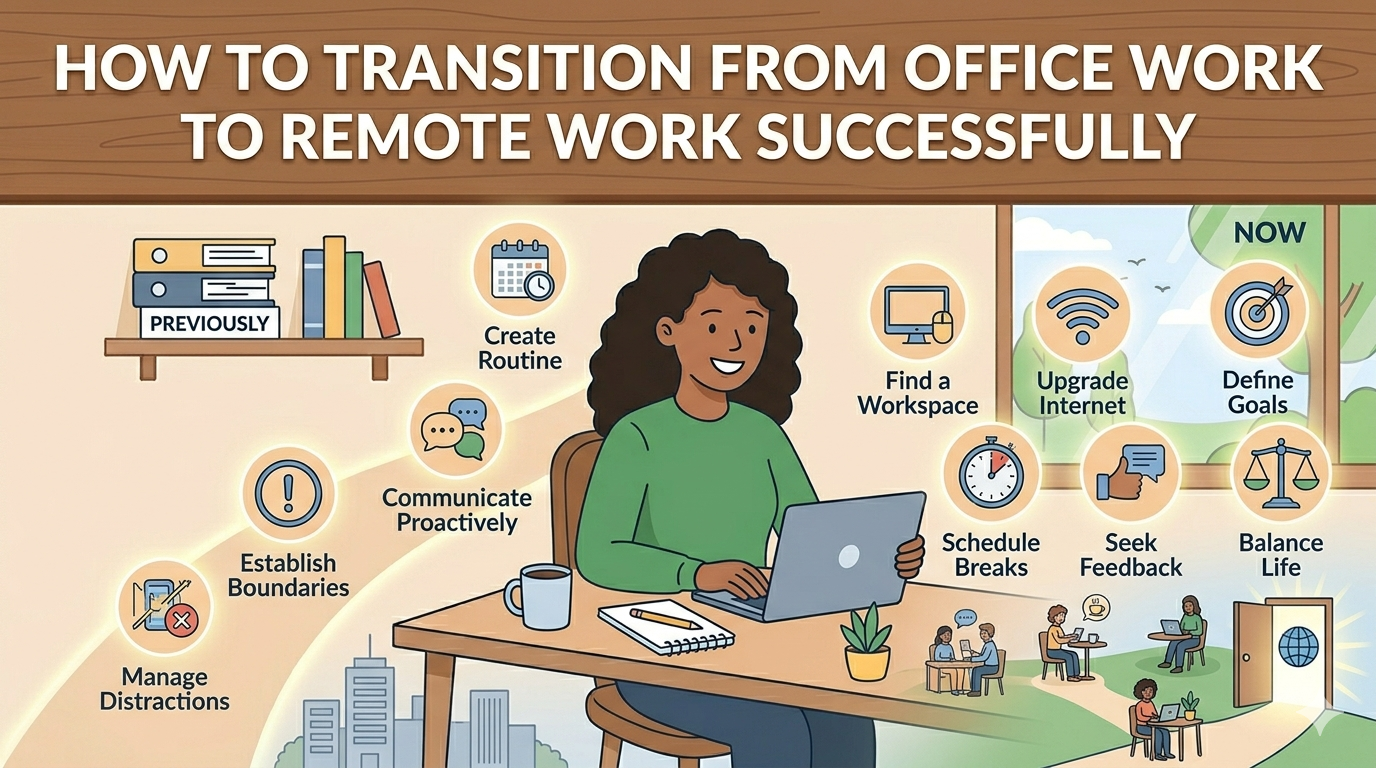
The traditional 9-to-5 office structure is undergoing a massive shift, and for many Nigerians in 2026, the dream of trading a grueling Lagos commute or a rigid office schedule for the comfort of a home office is more attainable than ever. However, moving from a supervised physical environment to a self-managed digital one is not just a change of scenery—it is a complete overhaul of your professional lifestyle.
Successfully transitioning to remote work requires a blend of psychological preparation, technical setup, and a strategic approach to communication. This guide provides a comprehensive roadmap for anyone looking to make the leap from the cubicle to the cloud.
1. The Mindset Shift: From “Being Seen” to “Being Productive”
In a traditional office, “visibility” often equates to “work.” If you are at your desk, your boss assumes you are working. In the remote world, visibility is replaced by tangible output.
-
Audit Your Work Habits: Before you leave the office, track how you spend your day. How much of your time is spent in deep work versus small talk? Remote work rewards those who can self-start and manage their time without a manager hovering nearby.
-
Embrace Autonomy: You are now the CEO of your own space. This means you are responsible for your own motivation. If you struggle with discipline, start practicing time-blocking techniques like the Pomodoro Method while you are still at your current office job.
-
Managing Expectations: Understand that remote work is not “less” work. In many cases, it requires more focus because the lines between home and office become blurred.
2. Preparing Your Technical Infrastructure
In Nigeria, the transition to remote work is often a battle of logistics. You cannot be a successful remote worker if you are constantly offline. Your transition plan must include a “Tech Audit.”
-
The Power Plan: Power instability is the biggest threat to your remote career. Before you resign from your office job, invest in a reliable power backup. This could be a high-capacity power bank for your laptop, an inverter system, or a solar setup.
-
The Internet Strategy: Never rely on a single Internet Service Provider (ISP). A successful transition involves having a primary fiber or 4G/5G connection and a secondary mobile hotspot from a different provider.
-
Hardware Requirements: Ensure your laptop meets the demands of modern software. If your work involves video calls, a decent webcam and a noise-canceling headset are non-negotiable.
3. Setting Up Your “Office” at Home
One of the biggest mistakes office workers make is trying to work from their bed or the dining table. To transition successfully, you need a dedicated workspace that signals “work mode” to your brain.
-
Ergonomics Matter: You might have taken your office chair for granted. At home, sitting in a poor-quality chair for eight hours will lead to back pain and decreased productivity. Invest in a good chair and a desk at the correct height.
-
The “No-Go” Zone: If you live with family or roommates, establish clear boundaries. When you are in your designated workspace, you are “at the office.” This is crucial for maintaining the deep focus required for high-level remote roles.
Internal Link: For a detailed list of what you need, read our guide on Work From Home Setup: What You Really Need.
4. Communication: The Lifeline of Remote Success
When you move out of the office, you lose the “watercooler effect”—the ability to lean over and ask a colleague a quick question. You must learn to become an over-communicator.
-
Master Asynchronous Communication: In an office, most communication is synchronous (real-time). Remotely, you’ll often use tools like Slack, Trello, or Email. Learn to write clear, concise messages that provide all the necessary context so your team doesn’t have to ask follow-up questions.
-
Visibility 2.0: Since your boss can’t see you working, you must make your progress visible. Send daily or weekly snippets of what you’ve accomplished. This builds trust, which is the currency of remote work.
-
Video Etiquette: Treat virtual meetings with the same respect as boardroom meetings. Dress appropriately (at least from the waist up) and ensure your background is professional.
5. Negotiating the Move with Your Current Employer
If you love your current company but hate the commute, your first step shouldn’t be quitting—it should be a proposal.
-
The Pilot Program: Suggest a trial period. Propose working from home two days a week for a month. Use this time to prove that your productivity actually increases when you aren’t stuck in traffic.
-
Focus on Results: When pitching to your boss, don’t talk about how remote work benefits you (e.g., “I want to save money on petrol”). Instead, talk about how it benefits the company (e.g., “I can start work earlier and focus on deep analysis without office distractions”).
-
Identify the Right Tools: Come to the meeting with solutions. Suggest using specific project management tools to keep everyone in the loop.
Internal Link: If your current boss says no, you’ll need a new strategy. See 10 Skills You Need to Start a Remote Career in 2026
6. Managing the Social and Physical Transition
The “loneliness” of remote work is real. Office workers are used to a social hum that disappears the moment they start working from home.
-
Schedule Social Interaction: Make an effort to leave the house. Join a co-working space once a week or meet friends for lunch.
-
The “Commute” Replacement: Use the time you used to spend in traffic to do something for yourself. Exercise, meditate, or learn a new skill. This helps create a “buffer” between your personal life and your work life.
-
Physical Activity: In an office, you naturally move around—walking to meetings or the breakroom. At home, you might stay sedentary for hours. Set a timer to stand up and stretch every hour.
7. Upskilling for the Digital Workplace
The skills that made you successful in a physical office might not be enough in a digital one. To transition successfully, you need to be tech-savvy.
-
Digital Literacy: You need to be comfortable with cloud-based tools (Google Workspace, Microsoft 365), project management software (Asana, https://www.google.com/search?q=Monday.com), and communication platforms (Zoom, Slack).
-
Self-Correction: Learn how to troubleshoot basic tech issues. If your Zoom isn’t working, you can’t call the “IT guy” to walk over to your desk. You need to be able to find the solution yourself.
Conclusion: Taking the Leap
Transitioning from office work to remote work is a marathon, not a sprint. It requires patience as you adjust your habits and significant planning to ensure your infrastructure is solid. By focusing on your output, mastering digital communication, and solving the local challenges of power and internet, you can enjoy a fulfilling and flexible career.
If you are ready to stop dreaming about remote work and start doing it, your next step is ensuring your application materials are ready for a global audience.