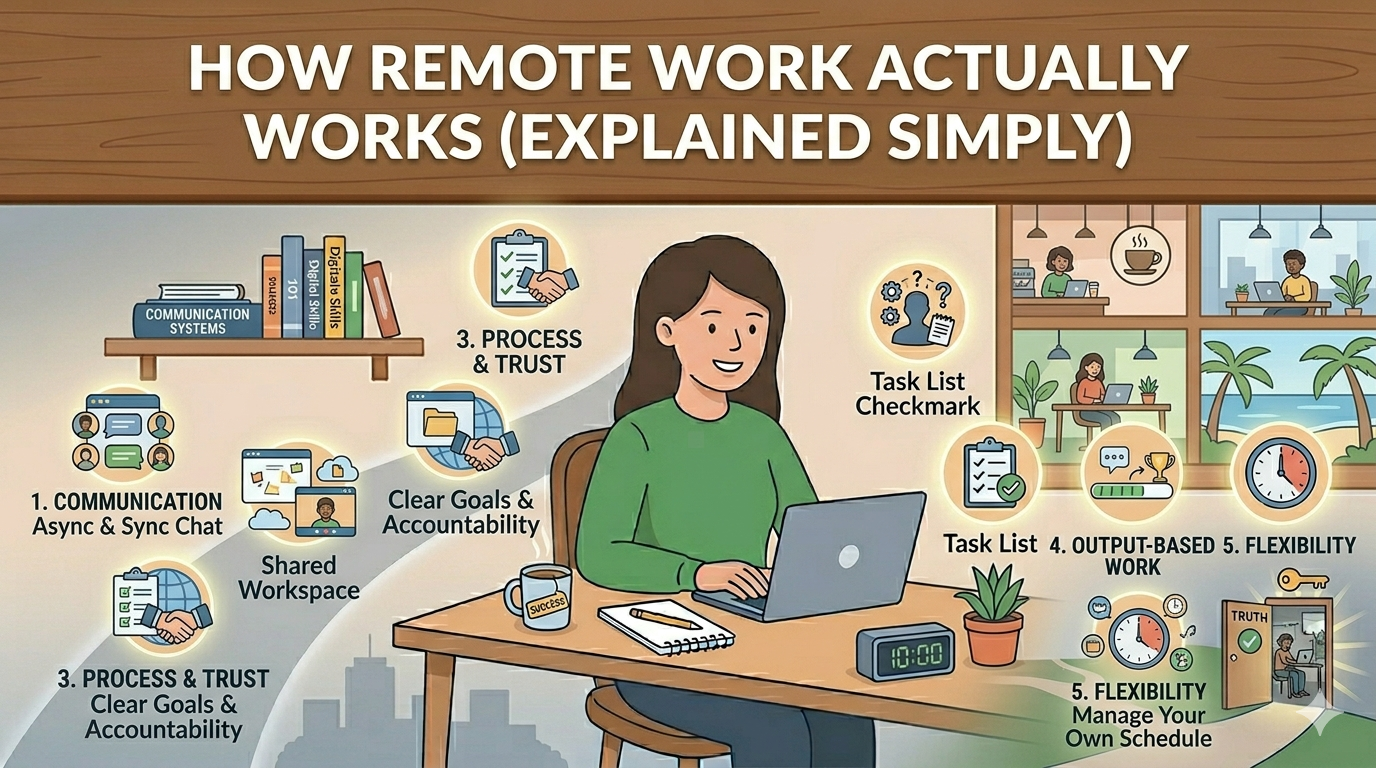
To the uninitiated, remote work looks like magic. You sit at a computer in Lagos or Abuja, perform a series of tasks, and money arrives in a digital wallet from a company based in London or San Francisco. Because there is no physical office, no punch-in clock, and no face-to-face supervision, many beginners struggle to understand the mechanics that keep this global engine running. To build a successful career, you must understand that remote work is not just “working from home”—it is a sophisticated ecosystem of cloud technology, trust-based management, and results-oriented economics.
The Ecosystem of the Virtual Office
In a traditional setting, the office building is the container for work. In the remote world, the “container” is a suite of software tools often referred to as a “Tech Stack.” When you join a remote company, you aren’t just getting a job description; you are being integrated into a digital architecture. This architecture usually consists of three main pillars: Communication, Project Management, and Documentation.
Communication tools like Slack or Microsoft Teams replace the office hallway. This is where the “vibe” of the company lives. Project management tools like Trello, Asana, or Jira act as the “manager.” They tell you exactly what needs to be done, when it is due, and who else is working on it. Finally, documentation tools like Notion or Google Drive act as the company’s “brain,” storing all the knowledge and instructions you need to do your job. Understanding that your “office” is a collection of tabs on your browser is the first step to mental clarity in this field.
The Shift from Synchronous to Asynchronous Work
One of the hardest concepts for beginners to grasp is “Asynchronous Communication,” or “Async” for short. In a physical office, work is mostly synchronous—you ask a question, and someone answers immediately. You have a meeting, and everyone is there at the same time. However, because remote teams often span different time zones, you cannot always wait for a real-time response.
How it works in practice is simple: you leave a detailed message or a comment on a task, and your colleague answers it when they start their workday in their respective time zone. This requires you to become a proactive planner. You cannot wait until the last minute to ask a question if your supervisor is eight hours behind you. This “delayed” rhythm is actually a superpower; it allows for long periods of “Deep Work” where you can focus without being interrupted by constant meetings or shoulder-taps.
This focus on output rather than hours is a major adjustment. If you are struggling to adapt to this new rhythm, our guide on The Truth About Remote Jobs: What Nobody Tells Beginners explains why your performance is now measured by what you produce, not how long you sit at your desk.
The Global Economic Pipeline
How does the money actually get to you? This is the part that confuses most people. Remote work works because of “Geo-Arbitrage.” This is a fancy term that means companies in high-cost economies (like the US or Europe) hire talent in emerging economies (like Nigeria). It is a win-win: the company saves on local salary costs and office overhead, while the Nigerian worker earns a salary that, when converted from Dollars or Pounds to Naira, is significantly higher than the local average.
In 2026, the payment pipeline has become seamless. Most remote workers use fintech platforms that provide them with “Virtual Global Accounts.” When your employer pays your salary, it lands in a US-based bank account in your name. You can then use these platforms to convert that currency to Naira at the current market rate and send it to your local Nigerian bank account. This financial bridge is the backbone of the remote work revolution in West Africa.
Trust: The Invisible Currency
You might wonder: “How does my boss know I’m actually working?” The answer is trust, backed by data. Remote work operates on a high-trust model. Employers assume you are a professional who wants to keep their job. However, this trust is verified through your “Digital Footprint.” Every time you update a task in Asana, push code to GitHub, or send a message in Slack, you are leaving evidence of your productivity.
Some companies use time-tracking software, but the best remote companies focus on “Results-Only Work Environments” (ROWE). In these companies, as long as your targets are met and your quality is high, they don’t care if you worked from 2:00 AM to 10:00 AM or the traditional 9-to-5. This autonomy is a gift, but it requires a level of self-discipline that many beginners aren’t prepared for.
Transitioning to this high-trust, high-autonomy model can be a shock to the system. To prepare yourself for this shift in responsibility, read our step-by-step instructions on How to Transition From Office Work to Remote Work Successfully.
The Role of “The Cloud”
Everything you do in a remote job happens “in the cloud.” This means your files aren’t saved on your computer’s hard drive; they live on servers that everyone on your team can access. This allows for real-time collaboration. Two people—one in Lagos and one in Berlin—can edit the same Google Doc or Figma design at the exact same time.
This is why your internet speed is so critical. If your connection is slow, the “sync” between your computer and the cloud breaks. You might find yourself working on an old version of a file or losing work because it didn’t save to the server. Understanding that your computer is merely a window into a shared digital space helps you realize why “staying connected” is your primary job requirement.
The Hiring and Onboarding Process
How do you actually “enter” a remote company? It usually starts with a “Cold Application” or a referral. Because the company cannot meet you in person, they rely heavily on your digital presence. Once hired, you go through “Virtual Onboarding.” You are given access to the company’s software, you might receive a “Welcome Package” via courier, and you are introduced to the team via a video call.
From day one, you are expected to navigate these digital tools independently. There is no physical “orientation” where someone walks you around the building. You are given a login, a handbook, and a list of tasks. This is where most people fail—they wait for someone to tell them what to do. In remote work, if you don’t know what to do, you are expected to search the company’s internal documentation or ask a clear, concise question in the team chat.
If you are ready to put this knowledge into practice and start your own journey into the cloud, follow our Step-by-Step Guide to Getting Your First Online Job to move from a curious observer to a hired professional.
Why It Matters for Nigerians in 2026
For a long time, Nigerian talent was limited by local geography. If the best jobs were in Lagos, you had to live in Lagos, regardless of the rent or the traffic. Remote work breaks these walls. It allows a developer in Enugu or a writer in Ibadan to compete on a global stage. It levels the playing field, making your location irrelevant and your skill paramount.
However, because you are competing with the world, the “how” of your work must be flawless. You must be as comfortable with Slack as you are with your smartphone. You must understand the etiquette of video calls and the discipline of time-blocking. Remote work is simple in theory, but it is an elite professional sport in practice.
Conclusion
Remote work is a combination of advanced technology and ancient human values like trust and reliability. It works because the digital tools of 2026 have finally caught up with our desire for freedom. By understanding the infrastructure of the virtual office, the importance of asynchronous communication, and the mechanics of global payments, you move from being a confused beginner to a savvy digital professional.
Now that you understand the “how,” it is time to focus on the “what”—the specific skills and actions that will make you a valuable asset to any global team.
Do you feel ready to step into the virtual office, or does the “cloud” still feel a bit foggy?