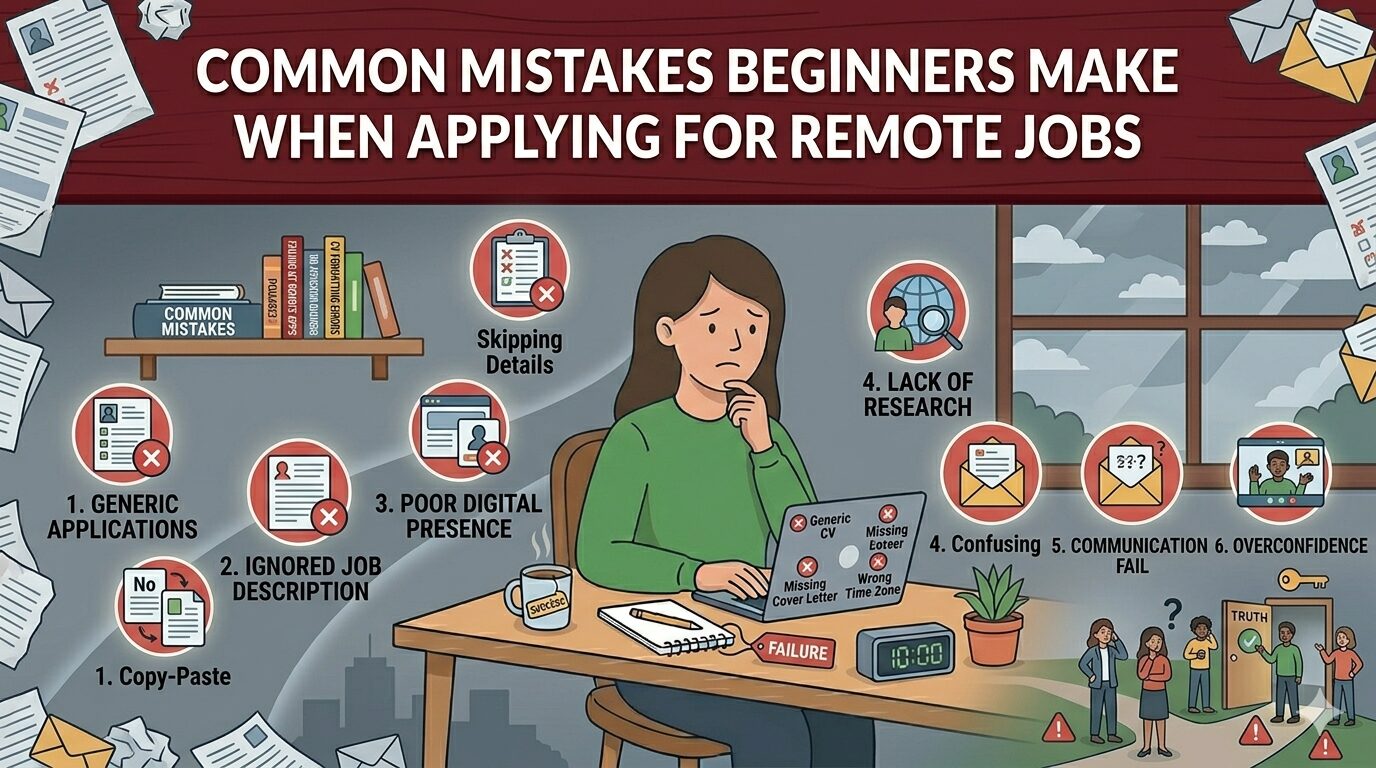
Common Mistakes Beginners Make When Applying for Remote Jobs
By now, the dream of a remote career in 2026 is clear. You understand the infrastructure, you’ve seen the step-by-step roadmap, and you’re ready to trade the stress of a physical office for the autonomy of a digital one. However, there is a reason why thousands of Nigerians apply for remote roles every day, but only a small percentage actually land the interview. In the world of remote hiring, the margin for error is razor-thin.
Because a recruiter cannot see your body language or meet you for a physical “vibe check,” they rely entirely on your digital trail. One small mistake in your application can signal that you aren’t ready for the discipline of a virtual environment. Let’s break down the most common pitfalls so you can bypass the “rejection pile” and move straight to the shortlist.
1. Using a “Nigerian-Standard” CV for Global Roles
This is perhaps the most frequent error. In the local Nigerian job market, it is common to include personal details like your date of birth, marital status, state of origin, and even your religion. When applying for a remote job with a company in the US, UK, or Canada, these details are not just unnecessary—they are often seen as unprofessional or a legal liability for the employer.
Global remote companies use Applicant Tracking Systems (ATS) to scan for skills, not personal history. If your CV is cluttered with your primary school’s name or your local government area, you are wasting valuable space that should be used for your “Digital Tech Stack.”
To ensure your CV meets the modern criteria, you must implement the changes we discussed in our Step-by-Step Guide to Getting Your First Online Job, specifically focusing on results over personal data.
2. The “Copy-Paste” Application Trap
In an attempt to “play the numbers game,” many beginners send the exact same cover letter to fifty different companies. This is the fastest way to get ignored. Remote recruiters are hyper-sensitive to generic applications because they need to know you have the specific communication skills required for their team.
If your application doesn’t mention the company by name or address the specific pain points mentioned in the job description, it signals that you are lazy. In a remote setting, laziness in an application is interpreted as laziness in the job. You must treat every application as a unique project.
3. Ignoring Time Zone Requirements
A beginner might see a job post for a “Social Media Manager” and apply instantly, ignoring the fine print that says “Must be available during EST hours (3:00 PM – 11:00 PM WAT).” If you apply for a job that requires you to be online during US business hours without mentioning how you will manage that shift, the recruiter will assume you didn’t read the post.
While one of the benefits of remote work is flexibility, many roles still require “synchronous” hours. Failing to acknowledge this shows a lack of attention to detail—a trait that is non-negotiable for anyone working without physical supervision.
4. Failing the “Silent” Tech Audit
Remote companies aren’t just hiring your skills; they are hiring your home office. A common mistake beginners make is sounding desperate about their local challenges. Phrases like “Please hire me, I need money to buy a generator” or “I am looking for a job that provides a laptop” are immediate red flags.
Your application must project the image of a fully functional, self-sufficient professional. You should mention that you have a stable power backup and high-speed internet as part of your “Professional Summary.” If you sound like you are waiting for the company to solve your basic logistics, they will hire someone from a region where those logistics are already solved.
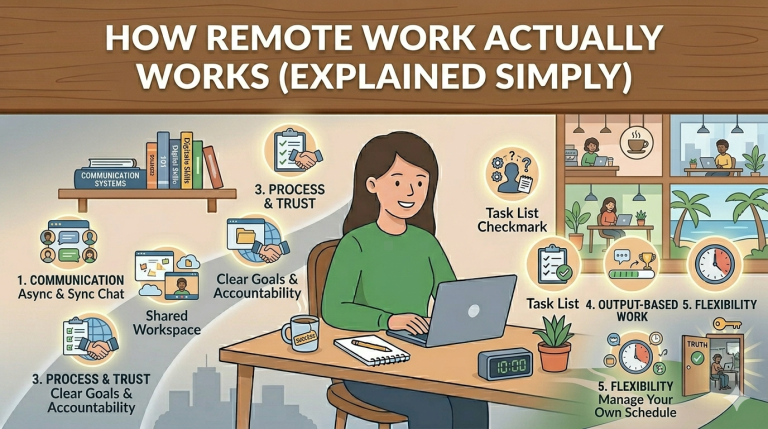
If you aren’t sure how to present your home setup professionally, refer to our breakdown on How Remote Work Actually Works (Explained Simply) to understand why your “infrastructure” is just as important as your talent.
5. Poor Digital Communication Etiquette
In a remote job, your writing is your personality. Beginners often use “text-speak” (e.g., “u” instead of “you,” or “i” instead of “I”) or send emails without a proper subject line. Even worse is the “Ghosting” habit—taking 24 hours to reply to an interview invite.
In the digital world, speed and clarity are the benchmarks of reliability. If you are slow to reply during the hiring process, the employer assumes you will be slow to reply when a client has an emergency. You must be proactive, professional, and grammatically perfect in every digital interaction.
6. Applying for “Everything” Instead of “Something”
There is a temptation to apply for every entry-level role you see—Customer Support, Data Entry, Virtual Assistant, and Content Writer. To a recruiter, this makes you look like a “Jack of all trades and master of none.”
Remote teams prefer specialists. They want the person who is obsessed with Customer Success, not the person who is just “looking for any work.” Focus your energy on one or two niches and build a portfolio that proves you are an expert in those specific areas.
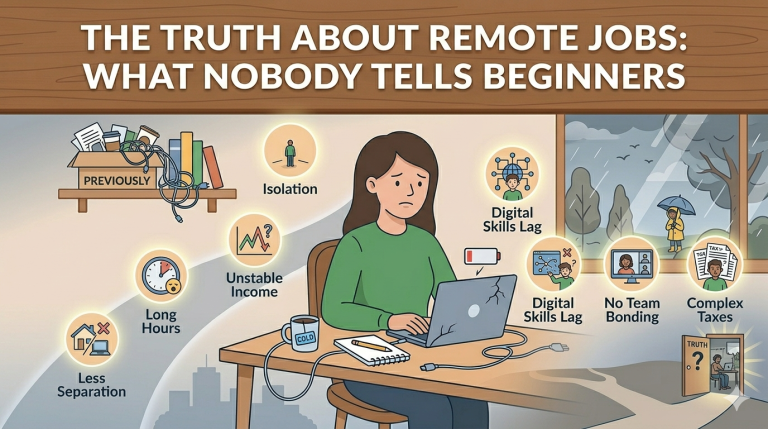
This specialized focus is part of the mindset shift we covered in The Truth About Remote Jobs: What Nobody Tells Beginners. Transitioning from a generalist to a specialist is how you move from low-pay to high-pay.
7. Having No “Digital Proof” of Work
In a physical interview, you can talk your way into a job. In a remote interview, you need to show your way into a job. Many beginners make the mistake of having no online presence. If a recruiter Googles your name and finds nothing—no LinkedIn profile, no portfolio, no GitHub, no published articles—you essentially do not exist.
You don’t need a fancy website, but you do need a “Live” portfolio. This could be a simple Google Drive folder with your best work, a optimized LinkedIn profile, or a collection of links to projects you’ve contributed to. Without proof, your claims of expertise are just words on a screen.
8. Neglecting the “Culture Fit”
Remote companies often have very strong cultures because they have to work harder to stay connected. A common mistake is focusing 100% on technical skills and 0% on personality. If a company describes itself as “fun, fast-paced, and quirky,” and your application is cold, robotic, and overly formal, you won’t fit.
Read the company’s “About Us” page. Look at their social media. Mirror their tone in your cover letter. They need to know that you are someone they can spend hours with on Zoom or Slack without it being awkward.
9. Asking About Salary Too Early
While earning in dollars is a major motivation for Nigerians, asking “How much does this pay?” in your first message is a turn-off for global employers. They want to know what value you bring to the table before they discuss what they will pay you.
Wait for the recruiter to bring up compensation, or wait until the end of the first interview. When you do discuss it, ensure you are talking in terms of “Annual Gross” or “Hourly Rate” in USD, rather than trying to calculate it in Naira on the spot.
10. Giving Up Too Soon
The final and most common mistake is the “One-Month Quit.” Many beginners apply for ten jobs, get ten rejections (or no replies), and decide that “remote work doesn’t work for Nigerians.”
The truth is that the first job is the hardest. It is a game of persistence. You are not just fighting for a job; you are fighting against the stereotypes of your region and the sheer volume of global competition. Every rejection is a lesson in how to tweak your CV, how to better your cover letter, or which platforms to avoid.
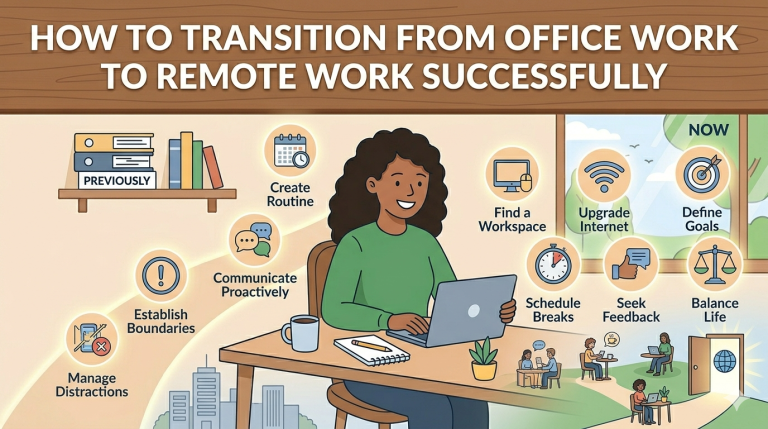
If you find yourself losing heart after a few rejections, revisit How to Transition From Office Work to Remote Work Successfully to remind yourself that this is a marathon, and the rewards of a successful transition are worth the initial struggle.
Conclusion
Avoiding these mistakes won’t guarantee you a job, but it will put you ahead of 90% of the other applicants. Remote hiring is a process of elimination. Recruiters are looking for any reason to say “no” so they can narrow down a list of 500 applicants to 5. By having a clean CV, a customized application, a solid tech setup, and a professional digital presence, you remove the easy reasons for them to skip over you.
The remote job market in 2026 is full of opportunities for those who are willing to be more professional, more prepared, and more persistent than the crowd. Stop making the mistakes that hold you back, and start positioning yourself as the global professional you are meant to be.
Which of these mistakes have you been unknowingly making in your search?