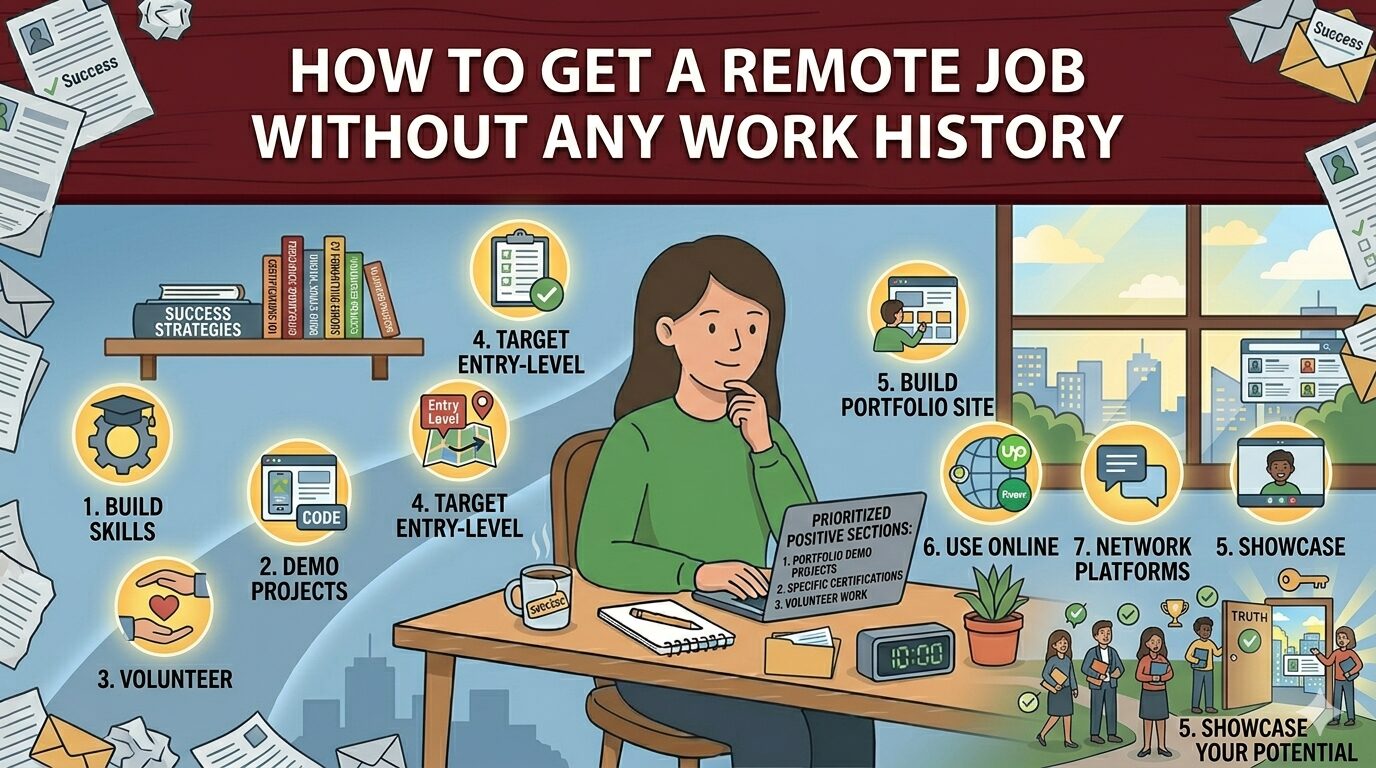
How to Get a Remote Job Without Any Work History
“How do I get experience if nobody will hire me to give me experience?” This is the classic “chicken and egg” problem that stops many talented Nigerians from even trying to work remotely. If you’re looking at international job boards and seeing “3 years experience required” for even the most basic roles, it’s easy to feel like the door is locked from the inside.
But here’s the secret: in the remote world of 2026, “Experience” doesn’t just mean a previous job title at a big company. It means proof of competence. Recruiters abroad aren’t obsessed with where you sat from 9 to 5; they are obsessed with whether you can actually do the job without someone holding your hand. If you have zero work history on paper, you don’t need a miracle—you need a strategy to manufacture credibility.
1. Stop Selling Your History, Start Selling Your “Stack”
When you don’t have a past, you have to sell the present. A common mistake is focusing your CV on your education or your lack of a job. Instead, pivot to your “Technical Stack.” In 2026, being “good with computers” isn’t a skill. Being an expert in Notion, Slack, Google Workspace, and Canva is a skill.
If you’ve spent the last three months mastering project management tools or learning how to use AI to speed up data entry, that is your experience. List these tools prominently. When an employer sees that you already know the software they use daily, the fact that you haven’t had a “boss” before becomes less relevant. You’ve lowered their “training cost,” and that makes you a low-risk hire.
2. The “Self-Initiated Project” Strategy
If nobody will give you a project, give yourself one. This is the most powerful way to bypass the “No Experience” barrier. If you want to be a Content Writer, don’t wait for a client; start a Substack or a Medium page and write ten high-quality pieces about a niche you love. If you want to be a Virtual Assistant, organize a mock “business week” for a friend or a local NGO for free, and document exactly what you did.
When you apply for a job, you can now say: “While I am looking for my first full-time role, here is a project I managed where I handled scheduling, email filtering, and report generation for a small organization.” This moves the conversation from “What have you done?” to “Look at what I am capable of.”
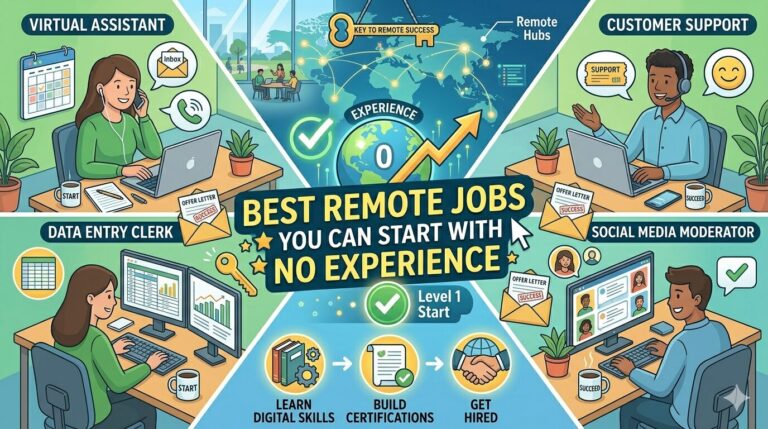
If you’re wondering which roles are most open to this kind of self-taught proof, check out our list of the Best Remote Jobs You Can Start With No Experience to see where your self-projects will have the most impact.
3. Leverage “Gig” Proof
One of the best ways to build a “history” quickly is through micro-task platforms. Spending two weeks on sites like Remotasks, Appen, or even doing small $5 gigs on Fiverr might not make you rich, but it does something more important: it proves you can follow instructions and meet deadlines.
When a recruiter sees you have a “Top Rated” badge or five 5-star reviews from random clients, it signals that you are reliable. In the remote world, reliability is often more valuable than a degree. These “gigs” act as mini-references that bridge the gap between “beginner” and “professional.”
4. Optimize Your LinkedIn Like a Pro
In 2026, if you aren’t on LinkedIn, you don’t exist to the global market. But don’t just create a profile and leave it empty. Use the “About” section to tell your story. Be honest but confident: “Aspiring Data Analyst with a deep obsession with clean spreadsheets and a mastery of SQL and Excel. Currently building a portfolio of public data sets.”
Join groups, comment on posts by leaders in your target industry, and share what you are learning. When you engage with the community, you aren’t just a “job seeker”—you become a familiar face. Sometimes, the best “work history” is a strong professional network that can vouch for your character.
5. Education is a Skill, Not Just a Degree
If you’ve taken online courses on Coursera, Udemy, or HubSpot, don’t just list the certificate. List the projects you completed during that course. Many Nigerians have certificates they never use. Stand out by explaining the practical application: “Completed Google Data Analytics Certificate, including a capstone project where I analyzed 12 months of sales data to identify trends.”
This shows you didn’t just watch videos to get a PDF; you actually applied the knowledge. To a remote employer, this proves you have the “Learn-it-all” mindset required to survive in a fast-evolving digital workspace.
Remember, how you present this learning matters. Avoid the Common Mistakes Beginners Make When Applying for Remote Jobs by making sure your certificates don’t look like “fluff” but like actual training.
6. Volunteering: The Professional Cheat Code
There are thousands of non-profits and small startups that need help but can’t afford a full-time staff. Offering your services for free for one month in exchange for a LinkedIn recommendation and a reference letter is the fastest way to get a “Work History.”
Whether it’s managing a church’s social media, helping a local charity with data entry, or assisting a small business owner with their emails, these are real-world tasks. On your CV, this isn’t “volunteering”—it’s a “Contract Role” or “Internship.” It carries the weight of a real job because the responsibilities were real.
7. The “Problem-Solver” Cover Letter
When you apply, don’t lead with “I am a beginner.” Lead with “I noticed your company is expanding its outreach, and I have developed a system to help manage that growth efficiently.”
A cover letter that addresses the company’s specific needs shows that you’ve done your research. It proves you have the analytical skills to understand a business, which is often more impressive than a two-year stint at a random office. You are selling your brain, not your past.
This approach is exactly what we discussed in How Remote Work Actually Works (Explained Simply)—it’s about the value you bring to the “cloud,” not the years you’ve spent in a chair.
8. Mastering the “Trial Task”
Many remote companies use trial tasks to vet beginners. This is your “Golden Ticket.” If you have no experience but you absolutely crush a 2-hour trial task, the company will hire you 9 times out of 10.
Practice for these. If you’re applying for Customer Support, practice writing empathetic, clear responses to angry emails. If it’s Data Entry, practice your speed and accuracy. When the trial comes, treat it like the most important exam of your life. It is the only thing standing between you and your first dollar-denominated salary.
9. The Power of “Native” Expertise
Sometimes, your “history” is simply where you live. Many global companies are looking to understand the Nigerian or West African market. If you’re applying for a role that involves market research, localizing content, or community management for an African audience, your experience as a “local” is your work history.
Don’t ignore roles that ask for “market insights.” Your lived experience is a data point that an Ivy League grad in the US can’t replicate. Use that to your advantage.
10. Stay Ready So You Don’t Have to Get Ready
The transition from “No Experience” to “Hired” can happen in a single afternoon. If you get an interview request, do you have your power backup ready? Is your internet stable? Do you have a professional background for your Zoom call?
Beginners often lose jobs not because they lack experience, but because they weren’t ready for the opportunity when it knocked. Be the professional you want to be before you get the salary.
If you’re still working a physical job while trying to build this new path, read How to Transition From Office Work to Remote Work Successfully for tips on balancing your current reality with your future goals.
Conclusion
“No experience” is a temporary state, not a life sentence. In the remote world of 2026, the walls are coming down for those who are willing to build their own doors. By focusing on your tech stack, creating your own projects, and offering value before you even have a contract, you prove that you are a professional.
Recruiters don’t want a history lesson; they want a solution to their problems. Be that solution, and the “No Experience” problem will disappear faster than you think.
Which self-project are you going to start this week to prove your skills?