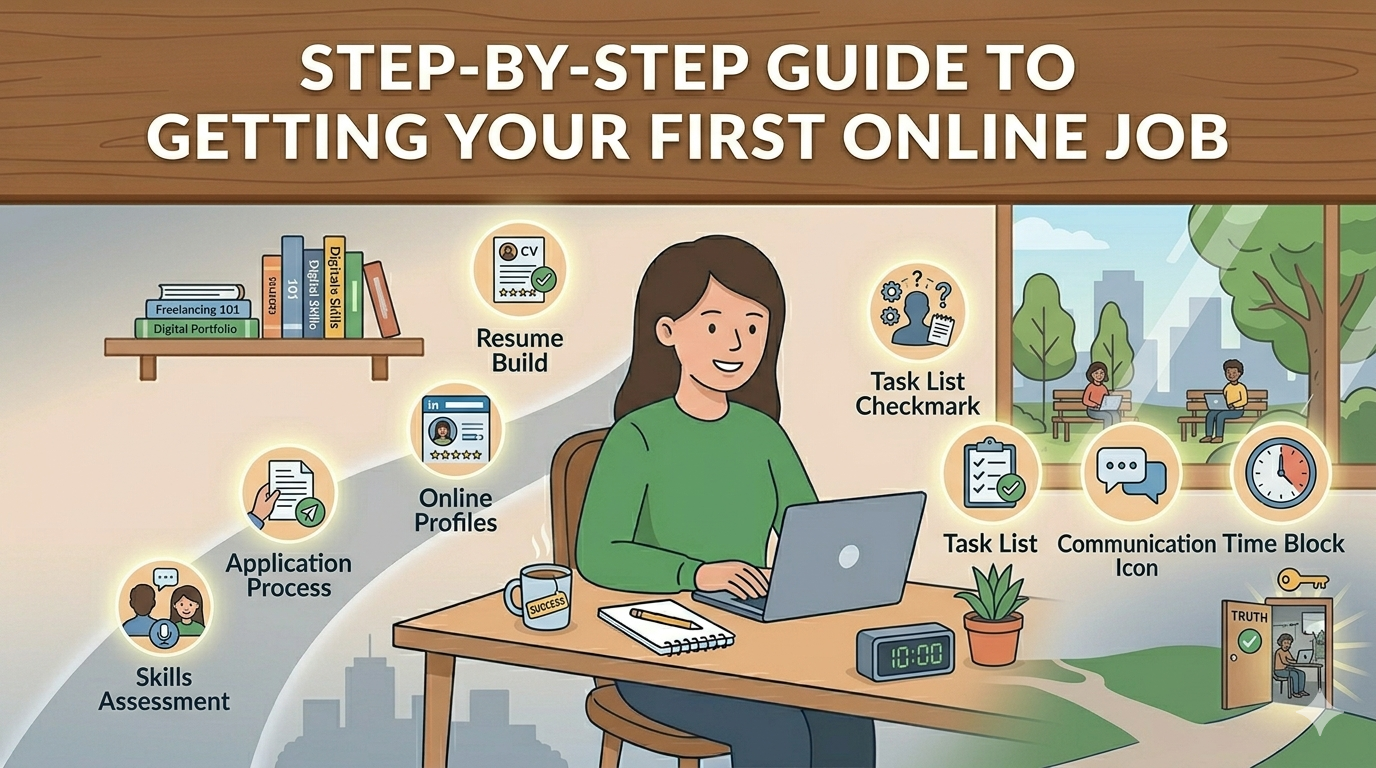
The journey from “I want to work online” to “I just received my first payment in dollars” is often the most difficult phase of a remote career. For many Nigerians in 2026, the barrier isn’t a lack of talent; it is a lack of a clear, repeatable process. The internet is a vast marketplace, and without a map, you can easily spend months applying for the wrong roles on the wrong platforms.
This guide breaks down the exact steps you need to take to secure your first legitimate online job, from the initial self-assessment to the moment you sign your first contract.
Step 1: Identify Your “Digital Product”
Before you open a single job board, you must define exactly what you are selling. In the online world, you are a service provider. Beginners often make the mistake of being too general, saying, “I can do anything.” To a remote recruiter, “anything” usually means “nothing.”
-
Audit Your Skills: Look at your previous office experience or your hobbies. Can you write? Can you manage schedules? Can you organize data?
-
Market Demand: Research which of your skills are currently in demand for 2026. Roles like Virtual Assistance, Customer Support, and Content Writing are excellent entry points.
-
The Specificity Rule: Instead of saying you are a “Virtual Assistant,” aim to be a “Virtual Assistant for Real Estate Investors.” Specificity allows you to charge more and reduces your competition.
Step 2: Fix Your “Remote-First” Infrastructure
You cannot win a global race while running with a lead weight. In Nigeria, your infrastructure is your reputation. If you drop out of an interview because of a power cut, you likely won’t get a second chance.
-
The Power Solution: Ensure you have at least 8–10 hours of backup power. This is the minimum requirement to stay competitive.
-
The Dual-Internet Rule: Never rely on one network provider. If you use MTN fiber, have an Airtel or Starlink backup ready.
-
Hardware: Ensure your laptop has at least 8GB of RAM and a working webcam. Speed and clarity are essential during the hiring process.
Step 3: Craft a Global-Standard CV and Profile
Your Nigerian CV format, which might include your date of birth, religion, or state of origin, will not work for international remote jobs. Global recruiters look for results and tools.
-
Remove Personal Data: Strip out age, gender, and marital status. These are irrelevant and can sometimes trigger unconscious bias.
-
Focus on Tools: Mention the software you use. Are you proficient in Slack, Trello, Google Workspace, or Zoom? List them clearly.
-
Quantify Your Achievements: Instead of saying “I managed a team,” say “I managed a remote team of 5, increasing output by 20% over 6 months.”
-
Optimize for ATS: Most remote companies use Applicant Tracking Systems. Use keywords found in the job description to ensure your CV actually gets seen by a human.
Step 4: Choose the Right Marketplace
Not all job boards are created equal. Depending on your skill level, you should focus your energy where you have the highest chance of success.
-
General Freelance Sites: Upwork and Fiverr are great for building a portfolio, though they are highly competitive.
-
Remote-Specific Boards: Sites like We Work Remotely or Remote OK are better for full-time roles with established companies.
-
Social Selling: LinkedIn is perhaps the most powerful tool for Nigerians in 2026. By optimizing your profile and engaging with industry leaders, you can often bypass the “application pile” entirely.
Step 5: The Art of the “Cold” Application
When you find a job that fits, your application needs to stand out. Most beginners send a generic “I am interested in this job” message. To win, you must be a problem solver.
-
The Custom Cover Letter: Address the specific pain points mentioned in the job post. If the company says they are “struggling with disorganized schedules,” your opening line should be about how you excel at calendar management.
-
Show, Don’t Just Tell: If you are applying for a writing job, send links to published work. If you are applying for a data entry role, offer to do a 15-minute trial task.
-
Follow Up: If you haven’t heard back in 5 days, send a polite follow-up email. This shows persistence—a trait highly valued in remote workers.
Internal Link: Remember, the way you present yourself here is the difference between being ignored and getting an invite. Review The Truth About Remote Jobs: What Nobody Tells Beginners to understand the level of global competition you are up against.
Step 6: Master the Virtual Interview
If you get the call, you are 80% of the way there. The virtual interview is your chance to prove that you are reliable and professional despite the distance.
-
Test Your Tech: 15 minutes before the call, test your audio, video, and background.
-
Lighting and Sound: Face a window for natural light and use a headset to minimize background noise (like the sound of a generator or neighborhood traffic).
-
The “Vibe” Check: Remote teams hire for culture as much as skill. They want to know if they can “sit” in a virtual room with you for 8 hours a day. Be professional, but let your personality show.
Step 7: Navigating the Trial Period
Most remote jobs start with a “paid trial” or a “probation month.” This is the most critical time in your new career.
-
Over-Deliver: If they ask for 5 tasks, deliver 6.
-
Ask Questions Early: It is better to ask for clarification on day one than to deliver the wrong work on day seven.
-
Build Relationships: Reach out to your new teammates. Introduce yourself and ask how you can make their jobs easier.
Step 8: Setting Up Your Payment Pipeline
Getting the job is half the battle; getting paid in Nigeria is the other half. You need to have your payment methods ready before the first invoice is due.
-
USD Accounts: Explore fintech options like Geegpay, Grey, or Payoneer that allow you to receive USD, GBP, or EUR and convert them to Naira at competitive rates.
-
Contracts: Never start work without a signed agreement or a platform-protected contract (like an Upwork Milestone). This protects you from the scams often found in the online space.
Step 9: Transitioning from “First Job” to “Career”
Your first online job might not be your dream job. It might be a low-paying data entry role or a basic customer service gig. That is okay. The goal of the first job is to get a review and experience. Once you have “Remote Work” on your CV, getting the second, higher-paying job becomes significantly easier.
If you are currently in a 9-to-5 and worried about making this move, our guide on How to Transition From Office Work to Remote Work Successfully will help you manage your time so you can hunt for that first job while still earning a salary.
Conclusion
Getting your first online job is a test of character and strategy. It requires you to refine your identity, upgrade your home infrastructure, and learn a new way of communicating with the world. While the process may feel overwhelming, following these steps ensures you aren’t just “trying” to work online—you are building a professional foundation that will support you for years to come.
The world is looking for talent, and as a Nigerian professional in 2026, you are perfectly positioned to fill that gap. Stop searching aimlessly and start following the plan.
What is the first skill you will put on your remote CV?